Notre-Dame reservation free
Yes, you can visit without booking. Cathedral entry is free for everyone. A reservation is optional and helps reduce waiting.
Your entry options
- Without a reservation: join the walk-in queue. Expect longer waits at busy times; entry depends on capacity.
- With a reservation: arrive during your chosen time slot for a shorter wait.
When to book
Book on your visiting day, a few hours before. Slots are added regularly; booking several days ahead is not available.
How to reserve
- Open the cathedral’s official website or app.
- Choose an available time in its booking portal.
- Complete the free reservation.
- Receive your digital ticket by email.
Explore the audio guide
Explore Notre-Dame at your own pace with a free audio guide.
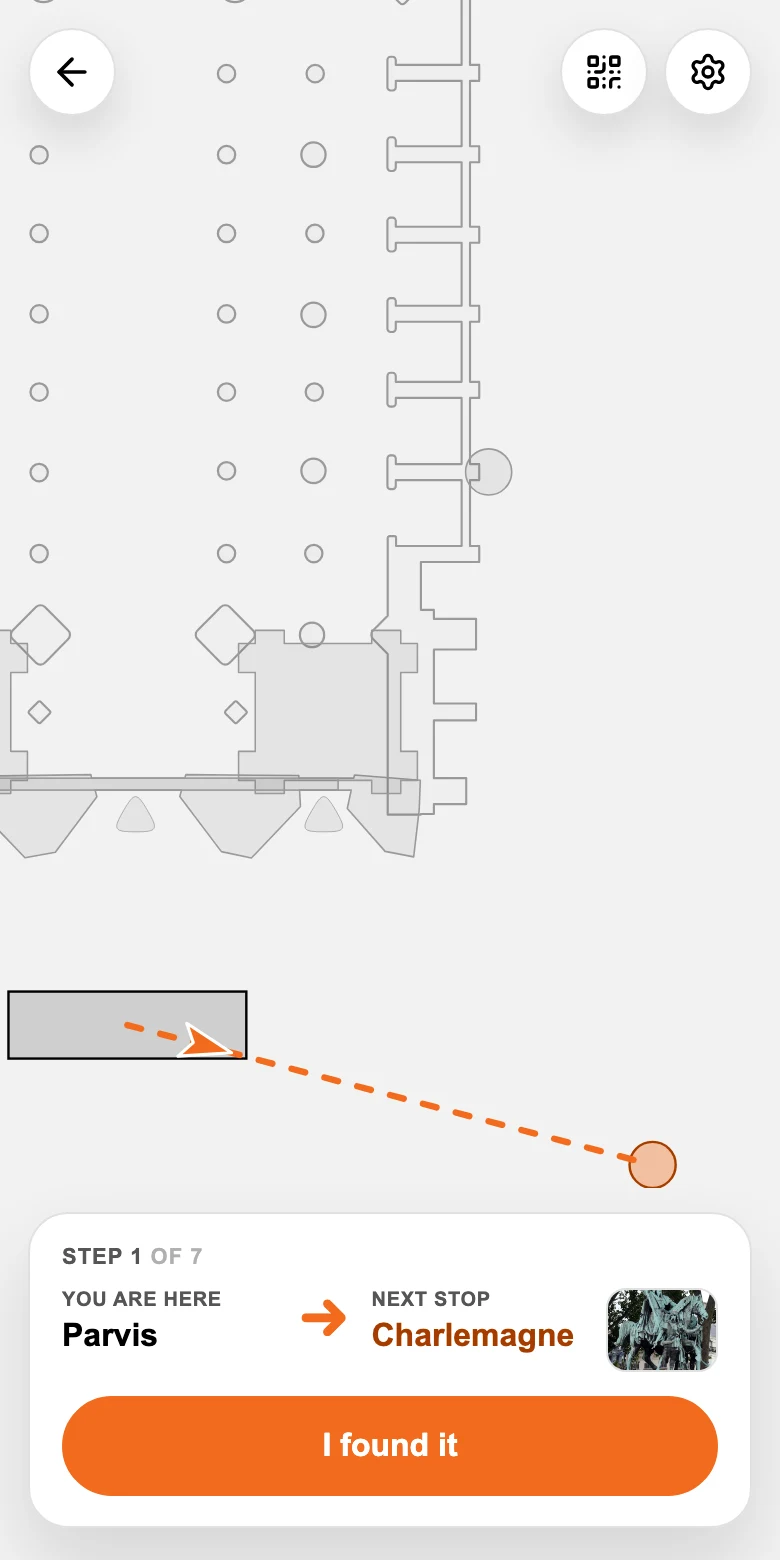
Follow a self-guided walking tour of 15 narrated stops using the interactive map, and choose the outdoor route, the indoor route, or both.
Whoever Started This Didn't Finish It
Notre-Dame · English narration · Free
Transcript
Look up slowly, not all at once. The face of this building doesn't match itself floor to floor. The bottom looks like one hand carved it. The higher you go, the more it looks like several hands lost the thread, then picked it back up their own way. That's not decline. It's inheritance. Work on this front started in 1200. Bishop Eudes de Sully pushed it forward. But he didn't invent the plan. He'd inherited it too, from a predecessor who'd already spent decades laying groundwork elsewhere on the building. Sully kept it moving. Then, in July of 1208, he died. What he left behind was a plan, and the plan was strict. Symmetrical, in three parts: three doorways, four heavy buttresses slicing the front into vertical strips, horizontal bands stacked across them. Doors, a long line of statues, the round window, a gallery of slender arches, then two towers. Everything below the towers comes out close to a perfect square. Le Corbusier, of all people, called it a pure creation of the mind, governed by the square and the circle. The successors mostly obeyed. Guillaume d'Auvergne carried it on, then a string of architects after him, until the towers were done around 1250. Fifty years, several minds, and the front still reads as one idea. Mostly. The two towers aren't twins. The north one, on your left, is wider than the south by about a meter, and the belfry openings and the piers around them are proportioned differently too. Viollet-le-Duc, who restored this building in the nineteenth century, pointed it out in 1856 and guessed that a slimmer south tower left more room for the bishop's house next door. It's a guess. No thirteenth-century record says so. Then there's what's missing. Spires were on the table in the thirteenth century. They were never built. The towers end in a flat lead terrace and a stone railing, and they've ended that way for nearly eight hundred years. So the grid is real, and so are the exceptions. Sully never saw it finished, and whoever finished it hadn't drawn it. Stand back far enough and your eye tidies the whole thing into symmetry. That's what a grid is for. It outlasts the people who bent it.